Abandoned Farm in the Dust Bowl (1938)
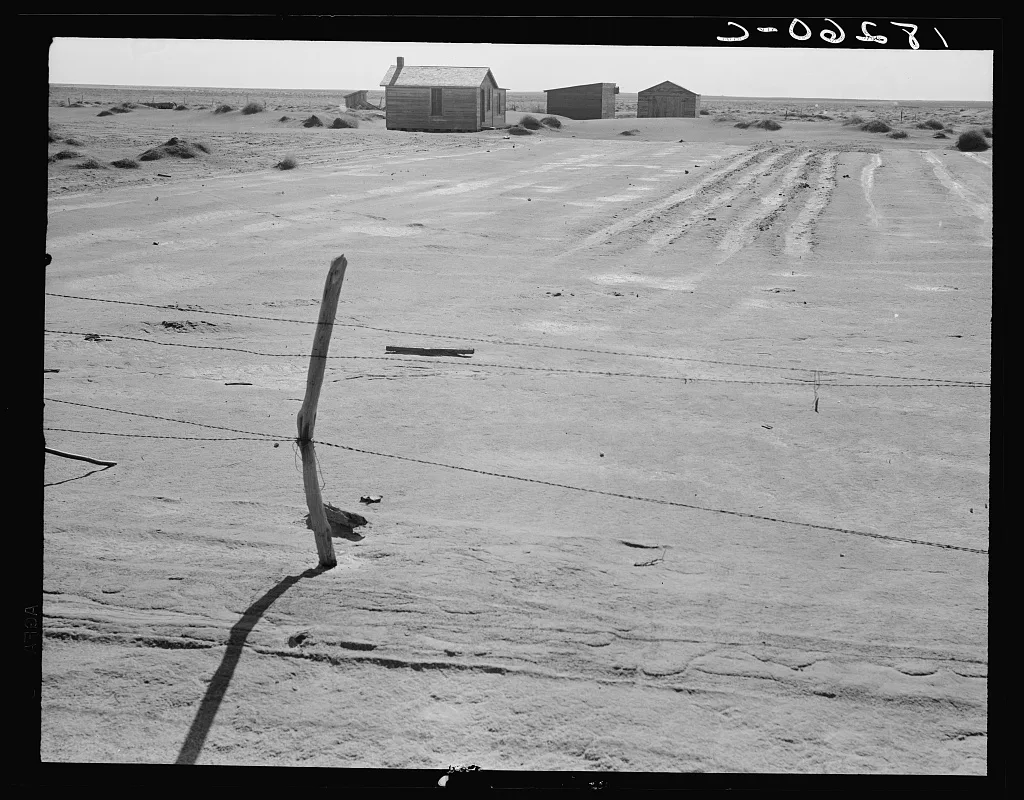
A leaning fence post, drifted sand and a cluster of empty buildings on the horizon: Lange's June 1938 view of an abandoned farm near Dalhart, Texas, shows the Dust Bowl as a landscape rather than a crowd of refugees.
- Date
- June 1938
- Medium
- 4 x 5 inch nitrate film negative; gelatin silver prints
- Location
- Coldwater District, near Dalhart, Dallam County, Texas
- Collection
- Library of Congress, FSA/OWI Collection, negative LC-USF34-018260-C (digital ID fsa 8b32404); prints at the Victoria and Albert Museum (CIRC.84-1973) and the Metropolitan Museum of Art (1972.737.11)
- Also known as
- Abandoned farm in the Dust Bowl. Coldwater District, near Dalhart, Texas; Abandoned Farm in the Dustbowl, Coldwater District, near Dalhart, Texas
Where and when it was made
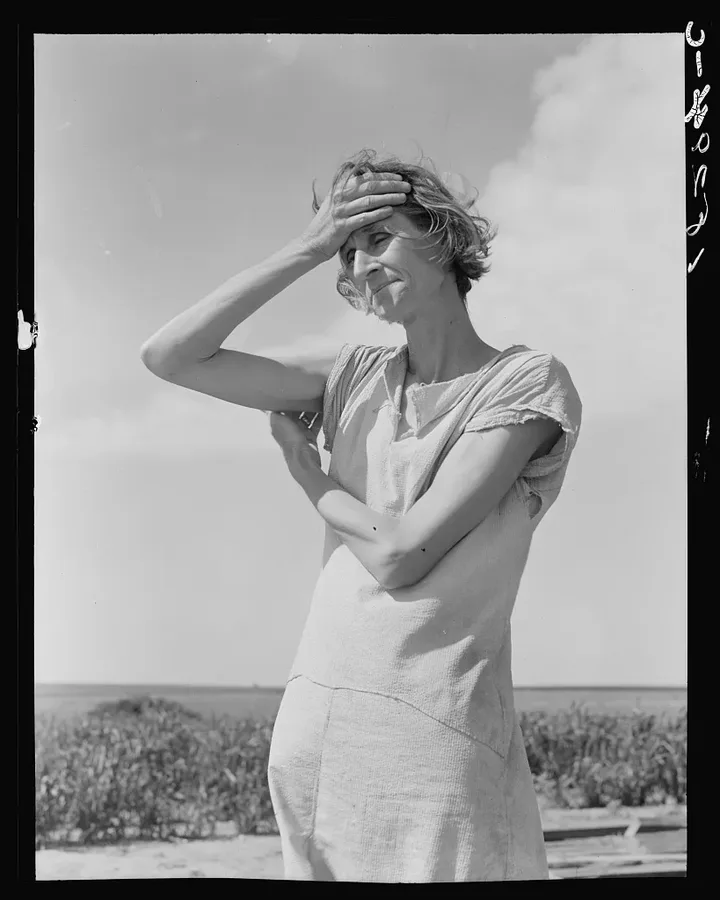
Lange made this photograph in June 1938 in the Coldwater District near Dalhart, in Dallam County at the far northwestern corner of the Texas Panhandle. She made it for the Farm Security Administration in the same month as her photographs near Childress, farther southeast in the Panhandle, including Woman of the High Plains. The Library of Congress caption is short and direct: abandoned farm in the Dust Bowl.
Dallam County sat near the center of the disaster. The Texas State Library notes that the great dust storm of April 14, 1935, known as Black Sunday, turned day into night in Dalhart, and quotes a 1935 observer who called the county "a vast desert, with miniature shifting dunes of sand." The federal government had chosen Dalhart in 1934 as the site of its Wind Erosion Control Project, an early experiment in holding the soil in place.
What the Dust Bowl did to farms like this one
The Handbook of Texas describes how prolonged drought, heat and strong winds combined with farming practices of the 1920s, when millions of acres of native grass were ploughed up, much of it for wheat. Once the rains failed, the bare soil blew. Dust storms of regional extent were recorded every year, with the most, 72, in 1937, the year before Lange's visit. The Handbook reports that between 1935 and 1937 more than a third of farmers in the area left.
Lange photographed several farms in the Coldwater District, and their captions show how mixed the picture was. One, also in this archive, notes that its farm was still occupied while others nearby had been abandoned. The farm in this photograph is the one she chose to caption simply as abandoned.
The Dust Bowl in numbers
The scale of the disaster helps explain why a single empty farm could stand for so much. The Texas State Library notes that the drought of 1930 to 1936 was centered on the Texas and Oklahoma Panhandles, where crop failures left some 500,000 people homeless, and that dust storms stripped as much as three quarters of the exposed topsoil. The Black Sunday storm alone lifted an estimated 300,000 tons of soil.
The Handbook of Texas puts the area of the Dust Bowl at about 100 million acres at its height in 1935. Amarillo recorded 908 hours of dust storms that year, and in May 1934 dust from the Plains fell as far away as Washington, D.C. Conservation work, including ridged ploughing, shelterbelts of trees and soil conservation districts created by the Texas legislature in 1935, slowly took hold, and by 1940 the affected area had shrunk to about 22 million acres. When Lange stood at this fence in June 1938 the area of the Dust Bowl was already shrinking, but for the family that had farmed this land, recovery had come too late.
What to look for
Almost nothing in this picture is a person, yet it is full of evidence. In the foreground a single fence post leans out of the sand, its barbed wire half buried, casting a long shadow toward the camera. Behind it the ground is ribbed and rippled where wind has piled sand over what were once ploughed rows, and the drifts run right up to the buildings. On the horizon sit a small house and two sheds, doors shut, with the flat land running out on either side under a pale, blank sky.
Lange used the large 4 x 5 inch negative to record every ridge of sand sharply from front to back. The low horizon and the empty middle distance make the buildings look small and far away, as if the land itself had pushed the family out. It is a picture of absence, and that is what makes it unusual among her portraits of migrants on the road.
Prints and where to see it
The original nitrate negative, LC-USF34-018260-C, is at the Library of Congress, and the image on this page is the Library's scan of it. In the early 1970s museums acquired prints made from the government negatives. The Victoria and Albert Museum in London acquired a large print, about 38 by 49 centimetres, from the Library of Congress in 1973, and the Metropolitan Museum of Art in New York holds a print made around 1972, a gift of Phyllis D. Massar. For close study, the Library's high-resolution scan of the negative shows every ridge of sand in the foreground.
Frequently asked questions
Where is the abandoned farm in Dorothea Lange's Dust Bowl photograph?
It was in the Coldwater District near Dalhart, in Dallam County in the northwestern Texas Panhandle. Lange photographed it in June 1938.
Why were farms abandoned in the Dust Bowl?
Years of drought, heat and wind stripped the topsoil from land that had been ploughed up in the 1920s. Crops failed, dust storms buried fields and fences, and according to the Handbook of Texas more than a third of farmers in the area left between 1935 and 1937.
Is Dorothea Lange's Dust Bowl farm photo in the public domain?
The negative was made for the Farm Security Administration and is held by the Library of Congress in its FSA/OWI collection, whose government photographs are generally free of known restrictions. Check the Library's catalog record for the current rights statement before reuse.
Which museums own prints of Abandoned Farm in the Dust Bowl?
The Victoria and Albert Museum in London and the Metropolitan Museum of Art in New York both hold prints made in the early 1970s from the Library of Congress negative.
Sources
- Library of Congress, Abandoned farm in the Dust Bowl. Coldwater District, near Dalhart, Texas (catalog record)
- Victoria and Albert Museum, Abandoned farm in the Dust Bowl (CIRC.84-1973)
- The Metropolitan Museum of Art, Abandoned Farm in the Dustbowl, Coldwater District, near Dalhart, Texas (1972.737.11)
- Handbook of Texas Online, Dust Bowl
- Texas State Library and Archives, Water: Extreme (Dust Bowl)
- Library of Congress, Dust Bowl farm. Coldwater District, near Dalhart, Texas. This farm is occupied (catalog record)