Stalled on the Desert (1937)
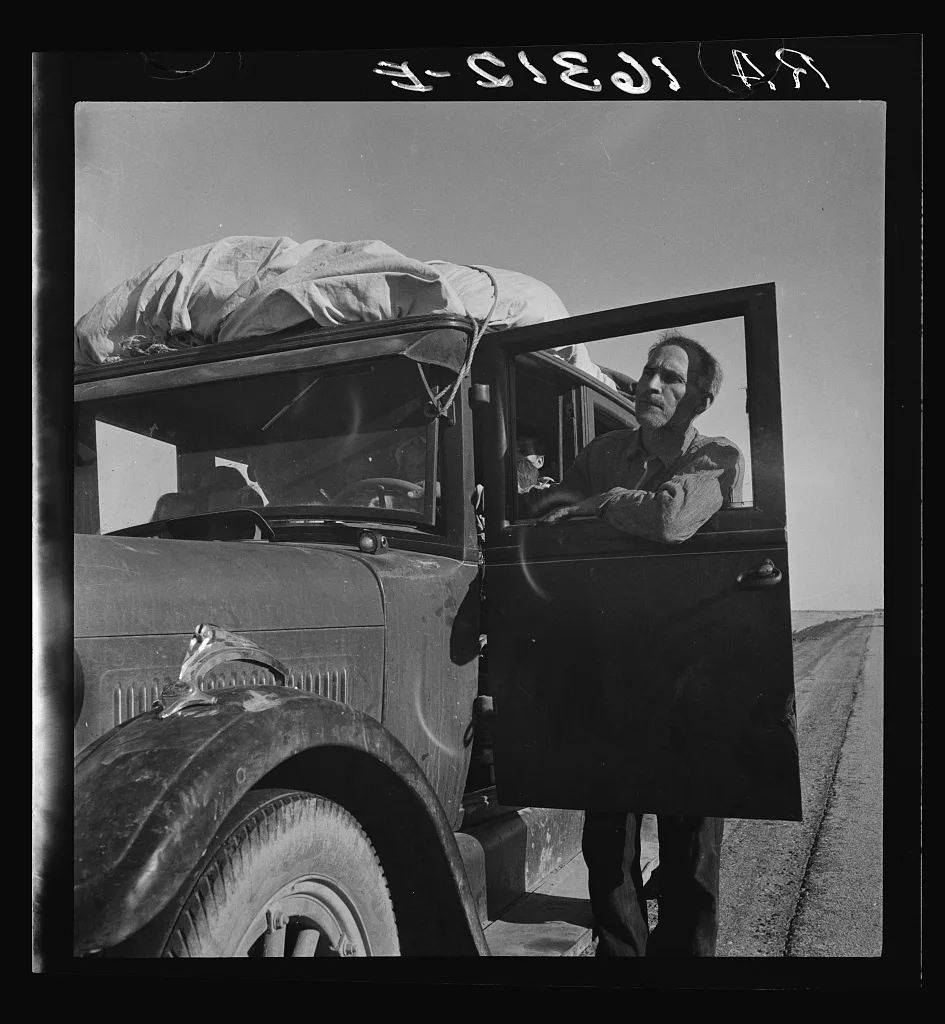
A gray-haired migrant leans on the open door of an overloaded car on an empty desert road. Lange's caption gives the rest: no money, ten children, from Chickasaw, Oklahoma, facing a future in California.
- Date
- March 1937
- Medium
- 2 1/4 x 2 1/4 inch nitrate roll-film negative; gelatin silver prints
- Location
- Desert of southern California
- Collection
- Library of Congress, FSA/OWI Collection, negative LC-USF34-016312-E (digital ID fsa 8b31796); prints at the International Center of Photography (1311.2005) and the New Mexico Museum of Art (2003.39.1, related frame)
- Also known as
- Stalled on the desert, facing a future in California. No money, ten children. From Chickasaw, Oklahoma. Southern California; Southern California desert. Migrant from Chickasaw, Oklahoma, stalled on the desert
Where and when it was made
Lange made this photograph in March 1937 on the desert of southern California, during the same trip that took her to the Imperial Valley to document migrant families arriving from the drought-stricken Plains. The Library of Congress files it in the same group of negatives, Lot 345, as her Imperial Valley pictures. At the time, according to the Library, as many as six thousand migrants a month were arriving in California from the Plains.
The caption, typed for the government file, does the work of a news story in a single line: stalled on the desert, facing a future in California; no money, ten children; from Chickasaw, Oklahoma. Like many of Lange's captions from this trip, it records the state a family came from, so that the pictures, taken together, map the migration out of the drought country.
What the picture shows
The man stands in the open driver's door of an old sedan, his forearms resting on the top of the door and his eyes narrowed against the glare. A bundle of belongings is lashed to the car's roof under a sheet. Behind him the road and its shoulder run straight to a flat horizon with nothing else in sight. The car's fender and worn tire fill the lower left corner, close to the lens.
Lange shot this frame on 2 1/4 inch roll film, which gives the square format. The camera is low and close, so the car looms large and the man is framed by the door like a figure in a window. Nothing in the picture explains what has gone wrong with the car or how the family will move on; the caption supplies the facts, and the picture supplies the waiting.
How Lange worked on the road
The trip that produced this picture was done on a shoestring. According to the Library of Congress, Stryker had laid Lange off for lack of funds in October 1936 and was able to rehire her only in late January 1937. She left for southern California with her friend Ron Partridge the day after the trip was approved, working long days and sleeping in cheap tourist courts paid for out of a four-dollar daily allowance. Writing to Stryker on February 16, she described a region swamped with homeless families, with relief offices open day and night and no work for the people still pouring in.
Partridge later described her method. She would walk through a field and talk to people, asking simple questions about what they were picking and how long they had been there, before asking to photograph them. If they began to pose, she would wait and move around until they forgot about the camera. A roadside encounter like this one gave her less time, but the result has the same quality: the man is aware of Lange, yet he is not performing for her.
The second frame
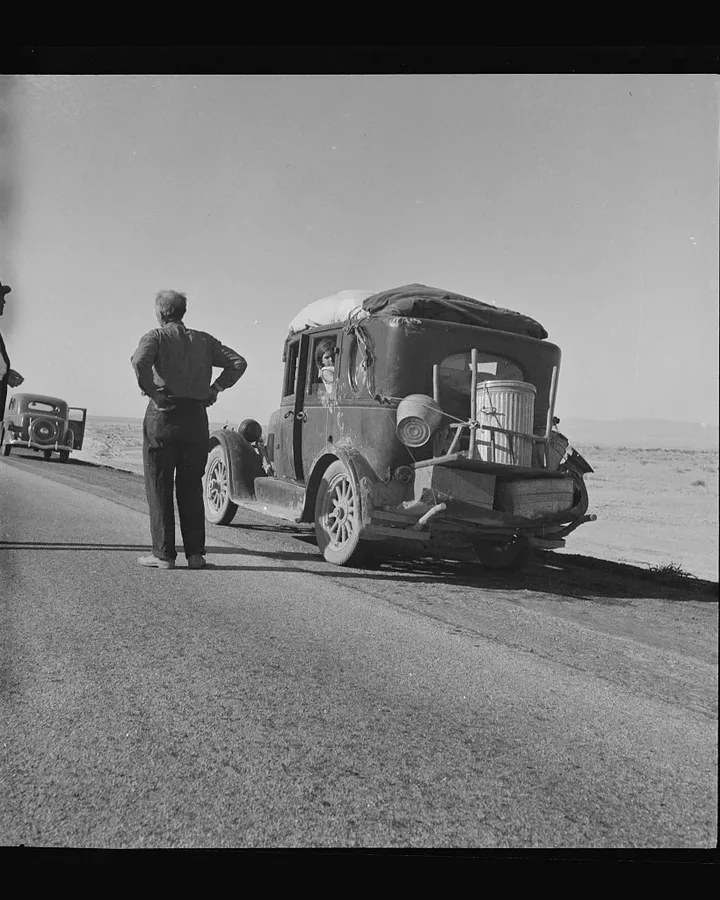
Lange made at least two exposures at the roadside. In the other frame, also in this archive, she stepped back. The man now stands in the road beside the car with his back to the camera, and other stalled cars are visible ahead. Its caption repeats the facts in a slightly different order: a migrant from Chickasaw, Oklahoma, stalled on the desert in southern California with no money, he and his ten children facing a future in California. The New Mexico Museum of Art, which owns a print of this wider view, describes a small child visible in the car window.
Seen together, the two frames show two ways of telling the same story. The wide view is about the road: one car among several, a man looking at a problem he cannot fix. The close view is about the man himself, and it is the one in which the caption's hard facts, no money and ten children, seem written on his face.
Prints and where to see it
The original nitrate negative, LC-USF34-016312-E, is in the Library of Congress FSA/OWI Collection, and the image on this page is the Library's scan of it. A print of this frame, about 19 by 19 centimetres, belongs to the International Center of Photography in New York, which acquired it in 2005 as part of The LIFE Magazine Collection. The New Mexico Museum of Art in Santa Fe bought a print of the related wider frame in 2003.
Other versions in the archive
Frequently asked questions
Where was Dorothea Lange's Stalled on the Desert taken?
On the desert of southern California in March 1937, during the trip on which Lange photographed Dust Bowl migrants arriving in the Imperial Valley. The caption does not give a more exact location.
Who is the man in the photograph?
His name was not recorded. The caption identifies him only as a migrant from Chickasaw, Oklahoma, with no money and ten children.
Why is the photograph square?
Lange made this frame on 2 1/4 inch roll film, which produces square negatives, rather than the larger 4 x 5 inch sheet film she used for pictures such as Migrant Mother.
Which museums own prints of Stalled on the Desert?
The International Center of Photography in New York owns a print of this frame, and the New Mexico Museum of Art owns a print of the related wider view. The original negatives are at the Library of Congress.
Sources
- Library of Congress, Stalled on the desert, facing a future in California (catalog record)
- Library of Congress, Southern California desert. Migrant from Chickasaw, Oklahoma (catalog record)
- International Center of Photography, Stalled on the desert, facing a future in California (1311.2005)
- New Mexico Museum of Art, Southern California desert. Migrant from Chickasaw, Oklahoma (2003.39.1)
- Library of Congress, Documenting America: Migrant Workers (Dorothea Lange, Imperial Valley, 1937)