Woman of the High Plains (1938)
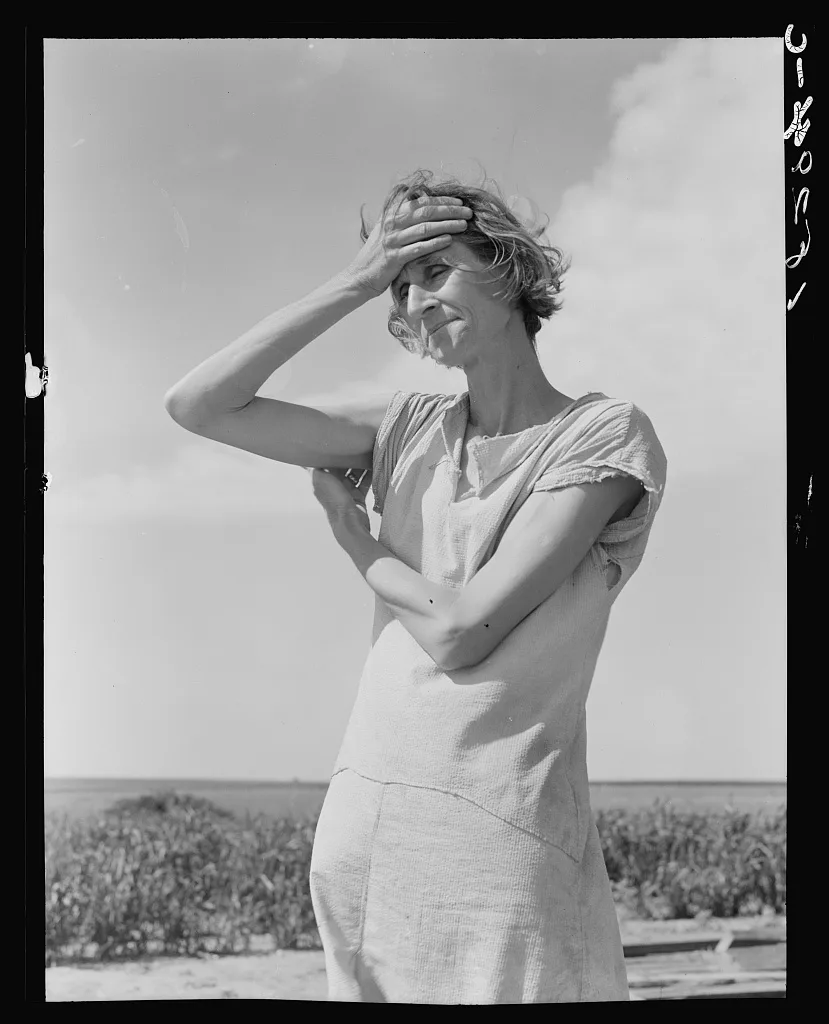
In June 1938, on the Texas Panhandle near Childress, Lange photographed Nettie Featherston, the wife of a migrant laborer, with one hand pressed to her forehead against a vast sky. The picture became one of Lange's most admired portraits of the Dust Bowl years.
- Date
- June 1938
- Medium
- 4 x 5 inch nitrate film negative; gelatin silver prints
- Location
- Near Childress, Childress County, Texas Panhandle
- Collection
- Library of Congress, FSA/OWI Collection, negative LC-USF34-018294-C (digital ID fsa 8b32434); prints at the Oakland Museum of California (A67.137.38111.4), National Gallery of Victoria (PH107-1975) and elsewhere
- Sitter
- Nettie Featherston
- Also known as
- Wife of a migratory laborer with three children. Near Childress, Texas. Nettie Featherston; Woman of the High Plains, Texas Panhandle; Nettie Featherston; Texas Panhandle (Woman of the High Plains)
How the photograph was made
In June 1938 Lange was photographing in the Texas Panhandle for the Farm Security Administration, recording farm families on the move during the Dust Bowl years. Near the town of Childress she met Nettie Featherston, whose husband was a migratory laborer.
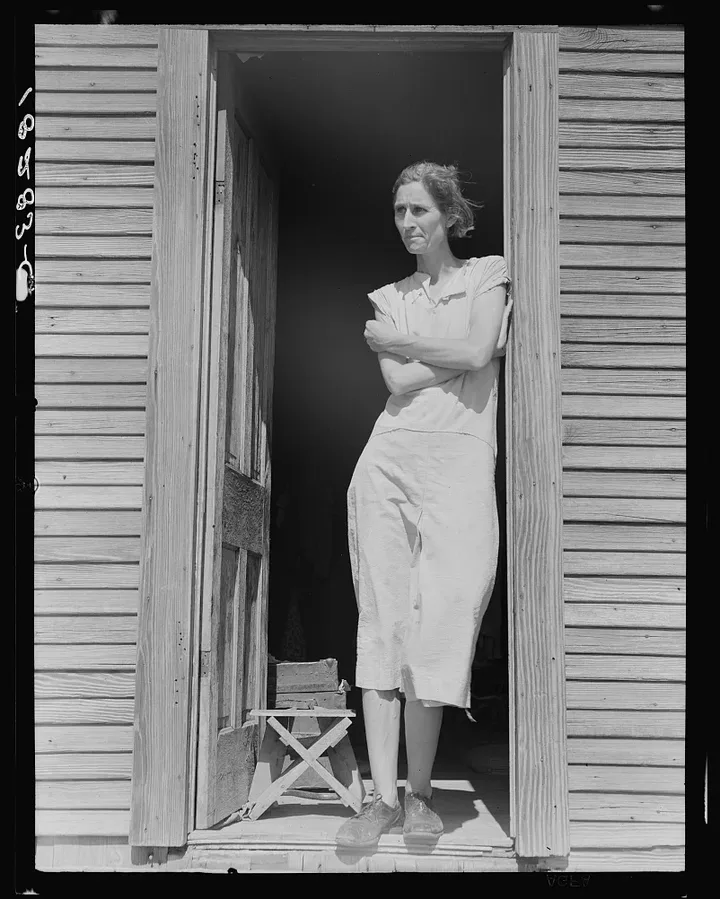
The file caption at the Library of Congress is plain: wife of a migratory laborer with three children, near Childress, Texas. Lange made at least two exposures of her on 4 x 5 inch film. In one, she stands in the doorway of a wooden house with her arms folded. In the other, the famous one, Lange stepped outside and photographed her against the open sky. The Oakland Museum of California notes that Lange's contact sheet from the session includes both 4 x 5 inch and 2 1/4 inch negatives, so she was working with more than one camera.
What she told Lange
Lange usually wrote down what her subjects said, and the words Featherston spoke have travelled with this picture. According to the caption reproduced by the Oakland Museum, she told Lange the family had had no work since March, had sold their car to buy food, and had no way to leave. The National Gallery of Victoria quotes her saying, "This county's a hard county. They won't help bury you here." Another line from the same conversation, often printed with the photograph, is "If you die, you're dead - that's all."
Forty-one years later, in August 1979, the photographer Bill Ganzel photographed Featherston again, in the four-room house she shared with her son in Lubbock, Texas. She was 81. In the interview published with that picture she recalled that the family had pulled cotton bolls for a grower near Carey through one winter, lived in a two-room house on black-eyed peas, and stayed behind while relatives left for California because, in her words, "we were so poor that we couldn't have went to California or nowhere else."
What to look for
Lange photographed Featherston from slightly below, so that she rises above a low horizon of scrubby crops into a sky that takes up most of the frame. Her right hand is pressed flat against her forehead; her left arm crosses her body and grips her elbow. The gesture can be read as worry, exhaustion or simply shading her eyes from the Panhandle sun, and Lange leaves it open. Her thin cotton dress and wind-blown hair are sharply recorded by the large negative.
Compare the second frame in this archive, made in a doorway. There the dark interior and weathered siding enclose her, and she looks guarded. In the open-air frame nothing surrounds her but land and sky, which is why later titles called her a woman of the high plains rather than a laborer's wife at a particular farm.
How it compares with Migrant Mother
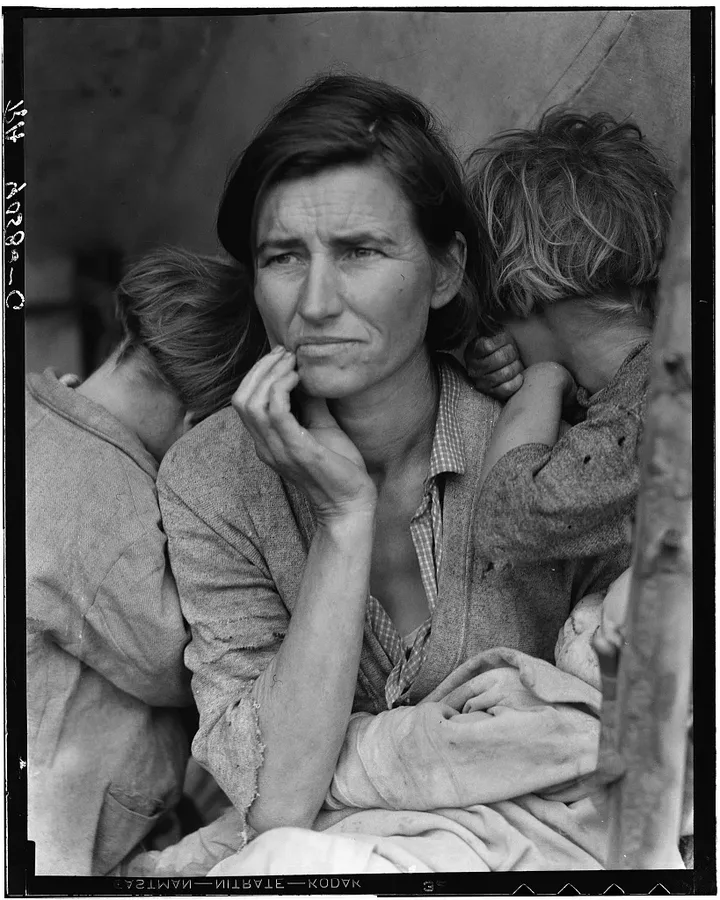
The two pictures are often shown together, and the comparison is useful. Both are portraits of mothers made for the same government project, and in both a raised hand carries much of the feeling. But Migrant Mother is close and enclosed: the frame is filled with faces and cloth, and the children press in from both sides. Woman of the High Plains does the opposite. Featherston stands alone, her children out of sight, and the space around her is as much the subject as she is. Where the Nipomo picture is about a family holding together, this one is about a person exposed to the land and the weather that had failed her. Neither caption names a cause, but the setting here, flat fields under a huge sky, places her squarely in the drought country of the Panhandle.
Titles, publication and legacy
The Oakland Museum, which holds Lange's own archive, points out that her photographs often appeared years after they were made and under several titles. This one is catalogued there as Woman of the High Plains (Nettie Featherston), Texas Panhandle, and is linked to An American Exodus, the 1939 book Lange made with her husband, the economist Paul Taylor. Lange returned to the image in the 1950s: the National Gallery of Art in Washington holds a print from that period presented as part of her project The American Country Woman.
The picture is now widely collected. Besides the Library of Congress negative, prints are held by the Oakland Museum of California, the National Gallery of Victoria in Melbourne (a print made around 1975 and purchased that year) and the National Gallery of Art, among others.
The version in this archive
The image on this page is the Library of Congress scan of the original nitrate negative LC-USF34-018294-C, the frame catalogued with Featherston's name. The doorway frame, negative LC-USF34-018283-C, is captioned "Migratory laborer's wife with three children (not in photo)" and is identified by the Library as showing Nettie Featherston; it is included here as a related view.
Other versions in the archive
Frequently asked questions
Who is the woman in Dorothea Lange's Woman of the High Plains?
She is Nettie Featherston, the wife of a migrant laborer, photographed near Childress, Texas, in June 1938. The Library of Congress caption names her, and the photographer Bill Ganzel photographed her again in Lubbock, Texas, in 1979.
Where was Woman of the High Plains taken?
Near Childress in Childress County, on the Texas Panhandle. Lange was photographing the effects of drought and farm mechanization across the region that month.
What did Nettie Featherston say to Dorothea Lange?
She told Lange the family had been out of work since March, had sold their car to buy food and could not leave the county. She called it a hard county that would not even help bury the dead.
Where can I see Woman of the High Plains?
The original negative is at the Library of Congress, which has digitized it. Prints are in collections including the Oakland Museum of California, the National Gallery of Art in Washington and the National Gallery of Victoria in Melbourne, though they are not always on display.
Sources
- Library of Congress, Wife of a migratory laborer with three children (catalog record)
- Library of Congress, Migratory laborer's wife with three children (not in photo) (catalog record)
- Oakland Museum of California, Woman of the High Plains (Nettie Featherston), Texas Panhandle
- Oakland Museum of California, Texas Panhandle (Woman of the High Plains)
- Living History Farm, Nettie Featherston handout (photographs by Dorothea Lange and Bill Ganzel)
- National Gallery of Victoria, Woman of the high plains, near Childress, Texas