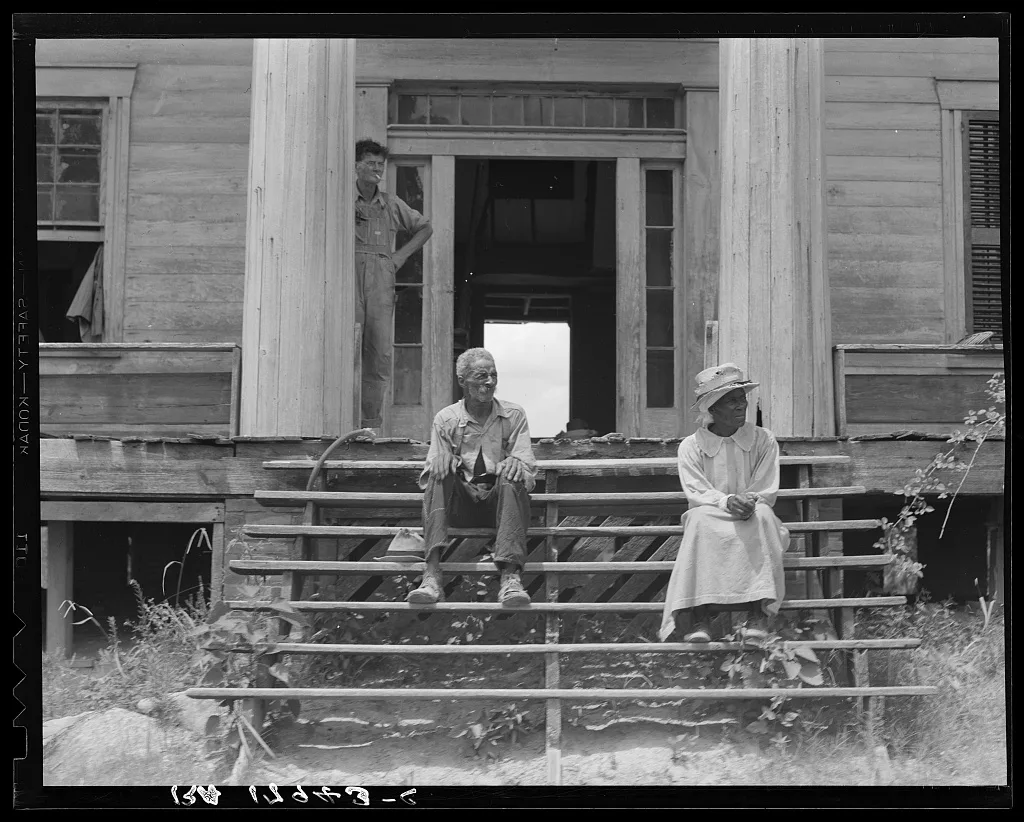
Ex-Slave and Wife, Greene County, Georgia (1937)
An elderly couple sit apart on the broken steps of a columned plantation house. Lange's July 1937 caption identifies the man as a former slave, linking the decay of the Old South's plantations to the people who still lived among them.
- Date
- July 1937
- Medium
- 4 x 5 inch safety film negative; gelatin silver prints
- Location
- Greene County, Georgia
- Collection
- Library of Congress, FSA/OWI Collection, negative LC-USF34-017943-C, Lot 1545; related close-up LC-USF34-017944-C
- Also known as
- Ex-slave and wife on steps of plantation house now in decay. Greene County, Georgia; Ex-slave and wife who live in a decaying plantation house. Greene County, Georgia
Where and when it was made
Lange photographed in Greene County, Georgia, in July 1937 for the Farm Security Administration. The county, a Black Belt community about eighty miles east of Atlanta, had already been studied closely by the sociologist Arthur F. Raper. According to the New Georgia Encyclopedia, Raper found that soil depletion, low cotton prices and the boll weevil were driving people off the land, and he published his findings in 1936 as Preface to Peasantry, arguing that the decaying plantation system had left its Black tenants dependent rather than independent.
Lange's captions from the county read like illustrations of that argument. She photographed standing chimneys in gullied fields, marking where plantation homes had once stood, and the Wray plantation, which her caption says covered 2,700 acres and had employed fifty tenant families in 1918 but only seven in 1937. She also photographed the people still living in what was left of the big houses.
Raper's work framed how outsiders saw the county for years. He chose Greene County, according to the New Georgia Encyclopedia, as a contrast with the more stable Macon County, to see how plantation life shaped the people who lived under it. After 1939 he went back to Greene County to observe the Unified Farm Program, a Farm Security Administration effort to improve health and farming for local tenants, and in 1943 he published a sequel, Tenants of the Almighty, on the federal recovery measures there. Lange's 1937 pictures sit between those two studies, recording the county after the collapse and before the government's attempts at repair.
What the picture shows
An elderly man and woman sit on the wide wooden steps of a two-storey plantation house with square columns. They sit apart, one at each side of the steps, the man in work clothes with his hands resting in his lap, the woman in a long pale dress and a hat. Behind them the front door stands open, and through the house you can see straight out to daylight at the back, as if the building were hollow. Weeds grow up around the steps.
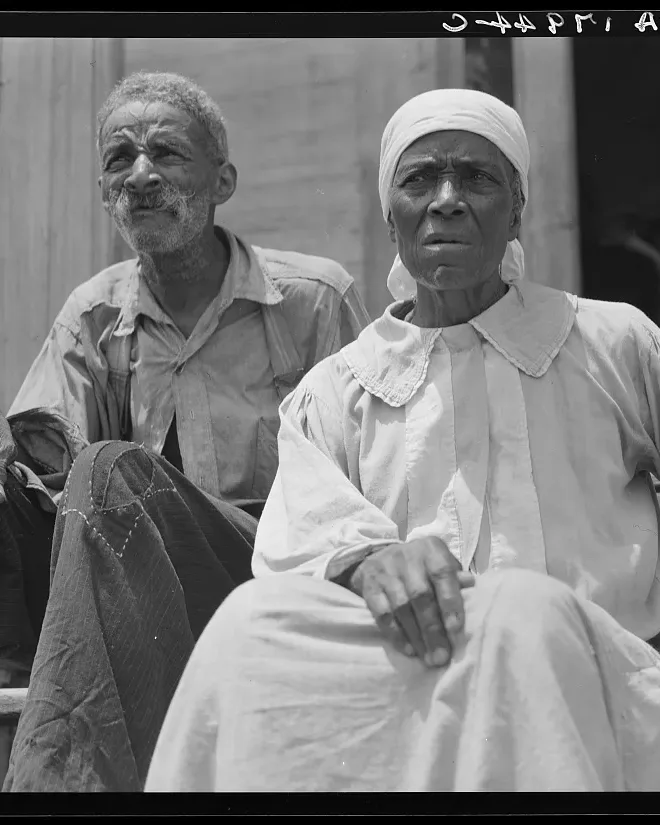
There is a third person in the picture: a younger man stands in the shadow of the porch beside the doorway. The caption does not mention him. The second frame in this archive, a close-up, shows only the couple, seated side by side and looking at the camera. Its caption says they live in a decaying plantation house.
Why the caption matters
Lange's caption is what turns this from a picture of an old house into a picture about history. A man born into slavery before emancipation in 1865 would have been at least in his seventies by 1937, and here he sits on the steps of the kind of house that slavery built, now falling apart. Across her Greene County captions, Lange keeps connecting the county's present poverty to its plantation past.
The caption also leaves a great deal out. The couple are not named, and we do not learn what they said, though Lange often recorded her subjects' own words elsewhere. Another caption from the same trip describes a decaying plantation house vacant except for two rooms occupied by an old couple who were tenants; the records do not say whether that is the same couple.
What to look for
Lange used the architecture as a frame. The two columns and the open doorway divide the picture into three bays, with the woman, the doorway and the man each in their own space. The steps run across the whole width like the lines of a ledger. The open door at the centre pulls the eye through the house to the bright square of light beyond, while the couple stay still in the foreground. The 4 x 5 inch negative records the texture of peeling boards and the creases of their clothing in detail.
The close-up works differently. With the house reduced to a pale wall behind them, the couple sit shoulder to shoulder and meet the camera directly, and the picture becomes a double portrait rather than a scene. Seeing both frames makes clear that the wider view was a deliberate choice to put the building, and its history, into the picture.
The version in this archive
The image on this page is the Library of Congress scan of negative LC-USF34-017943-C, captioned "Ex-slave and wife on steps of plantation house now in decay." The jacket of the original negative is marked with Lange's initials, DL. The related close-up, LC-USF34-017944-C, is included here as a second view. Both are filed with Lange's other Greene County photographs in Lot 1545 of the FSA/OWI Collection.
Other versions in the archive
Frequently asked questions
Who are the people in Dorothea Lange's ex-slave and wife photograph?
They are not named in the records. The Farm Security Administration caption identifies the man as a former slave and the woman as his wife, living in a decaying plantation house in Greene County, Georgia, in July 1937.
Why did Dorothea Lange photograph Greene County, Georgia?
The county had become a well-known example of the collapse of Southern plantation farming. Sociologist Arthur Raper had documented its soil depletion, falling cotton prices and outmigration in his 1936 book Preface to Peasantry, and Lange's pictures record the same conditions.
Is there more than one version of this photograph?
Yes. The Library of Congress holds two negatives: a wider view of the couple on the steps of the house and a closer view of the two of them seated together. Both are in this archive.
Where can I see the original photograph?
The original 4 x 5 inch negative is in the Farm Security Administration/Office of War Information Collection at the Library of Congress in Washington, which has digitized it. It is catalogued as LC-USF34-017943-C.
Sources
- Library of Congress, Ex-slave and wife on steps of plantation house now in decay (catalog record)
- Library of Congress, Ex-slave and wife who live in a decaying plantation house (catalog record)
- Library of Congress, Standing chimneys are a common sight in Greene County, Georgia (catalog record)
- New Georgia Encyclopedia, Arthur F. Raper (1899-1979)
- Library of Congress, Plantation house where the Wray family has lived for generations (catalog record)
- Library of Congress, A plantation house decaying and now vacant but for two rooms occupied by an old couple (catalog record)