Migrant Mother (1936)
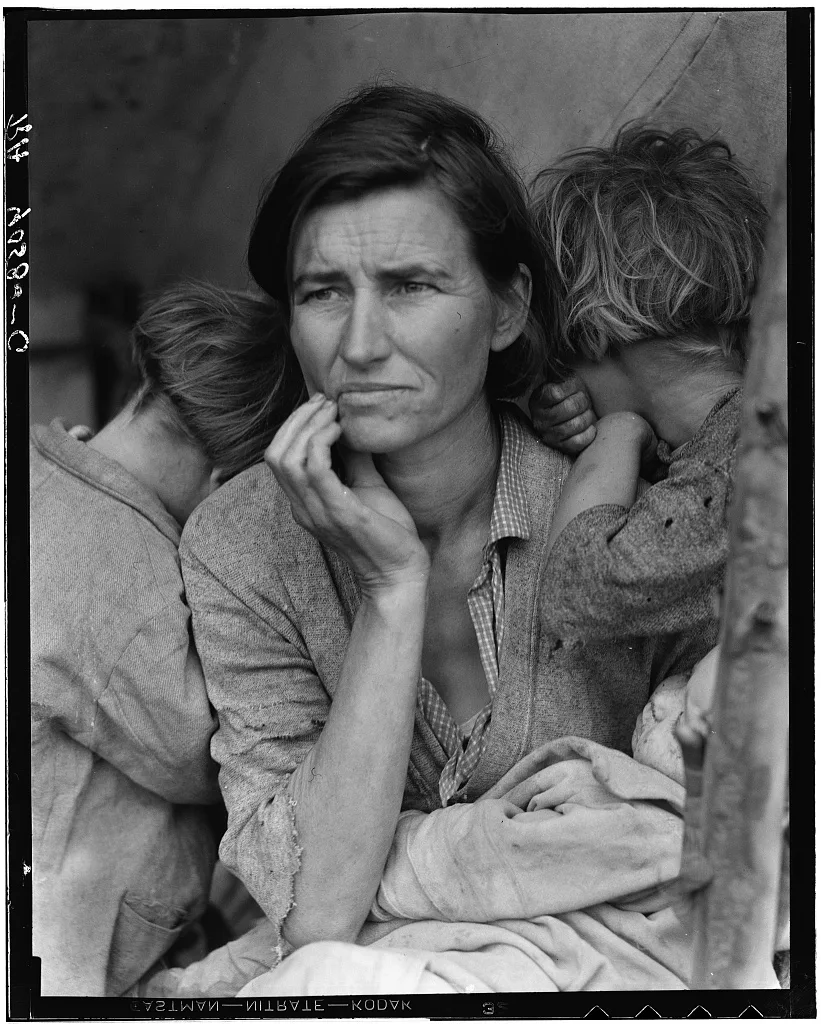
In March 1936, at a pea pickers' camp in Nipomo, California, Dorothea Lange photographed Florence Owens Thompson and her children in a handful of exposures. The closest frame became the defining image of the Great Depression.
- Date
- March 1936
- Medium
- 4 x 5 inch nitrate film negative (Graflex camera); gelatin silver prints
- Location
- Pea pickers' camp, Nipomo, San Luis Obispo County, California
- Collection
- Library of Congress, Prints and Photographs Division, FSA/OWI Collection, negative LC-USF34-009058-C (digital ID fsa 8b29516); print at the Museum of Modern Art, New York (331.1995)
- Photographer's employer
- Resettlement Administration (later the Farm Security Administration)
- Also known as
- Destitute pea pickers in California. Mother of seven children. Age thirty-two. Nipomo, California; Migrant Mother, Nipomo, California; Destitute peapickers in California; a 32 year old mother of seven children
How the photograph was made
By early March 1936 Lange had been photographing migrant farm labor in California for the Resettlement Administration for about a month and was driving home. According to the Museum of Modern Art's study of the picture by curator Sarah Meister, she passed a sign for a pea pickers' camp near Nipomo, kept going for roughly twenty miles, then turned back.
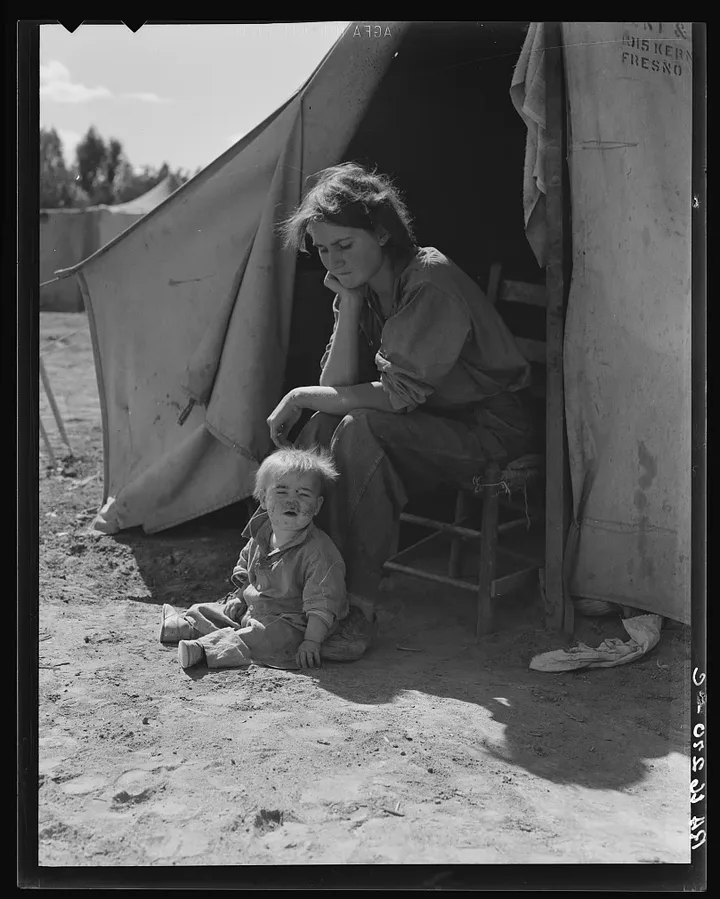
At the camp she found a woman with her children under a makeshift lean-to tent. Lange worked with a Graflex camera on 4 x 5 inch film and, in her own later account, "made five exposures, working closer and closer from the same direction." She spoke only briefly with the woman and did not write down her name. In the same account, published in Popular Photography in 1960, Lange recalled that the mother told her she was thirty-two, that the family had been living on frozen vegetables from the fields and birds the children killed, and that she had just sold the tires from her car to buy food. Lange also wrote that the woman seemed to know her pictures might help, "and so she helped me."
Who is in the picture
The woman was Florence Owens Thompson. Her name did not become public until 1978, when she wrote to the Modesto Bee and an Associated Press story followed. She was Cherokee and had been born in Oklahoma, a fact that unsettled the long-standing assumption, shared by Lange, that the woman in the picture was white.
Thompson's own family remembered the day differently from Lange. Her son Troy Owens later said the family's car had broken down and two of the older boys were in town getting the radiator repaired. He denied that his mother had sold the tires and suggested Lange had mixed up one story with another. Thompson said she felt exploited by the picture, and she received little benefit from it. In the final close frame she holds her baby, Norma, while two of her other children turn their faces away and lean against her shoulders. Meister's study identifies the other children seen across the series as Katherine, six-year-old Ruby and twelve-year-old Viola.
Why it became famous
The pictures reached the public almost at once. On March 9, 1936, the San Francisco News reported on its front page that 2,500 stranded pea pickers at Nipomo were being rescued from hunger, crediting an unnamed Resettlement Administration photographer with discovering the camp. The next day the paper ran two of Lange's frames with a United Press story saying 20,000 pounds of food were on the way. On March 11 the News published the close-up for the first time, beside an editorial asking what the New Deal meant to this mother and her children and urging support for federal camps for migrant workers. By the time the food arrived, according to HISTORY, Thompson's family had already moved on.
The picture then circulated in books, magazines and exhibitions. It appeared in Archibald MacLeish's 1938 photobook Land of the Free, though Lange and Paul Taylor left it out of their own 1939 book, An American Exodus. Roy Stryker, who ran the government photography unit, later said of it: "that was the ultimate. She never surpassed it." In 1998 the U.S. Postal Service put it on a 32-cent stamp. Because Lange made it as a federal employee, the image is in the public domain, which helped it spread onto everything from book covers to posters.
What to look for
Lange framed the final exposure so tightly that the camp, the tent and the hungry crowd described in the newspapers all disappear. What is left is a triangle of figures: the mother's face in the middle, a hand raised to her chin, and two children whose faces are hidden against her shoulders. Because we cannot see their faces, the children read less as individuals and more as anyone's children. The large negative records fine detail, from the frayed cloth of her sleeve to the lines on her forehead.
The file print in the Library of Congress shows one change made after the shoot. In the original negative, Thompson's thumb was visible gripping a tent pole in the lower right corner. The negative was retouched in the 1930s to erase it, and an earlier print made before the retouching survives and shows the thumb.
Versions and the frames in this archive
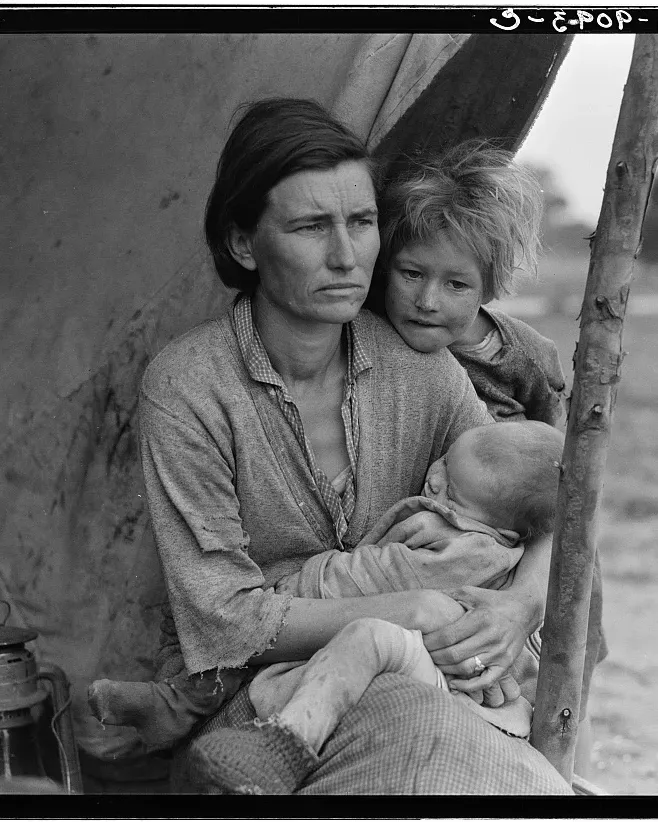
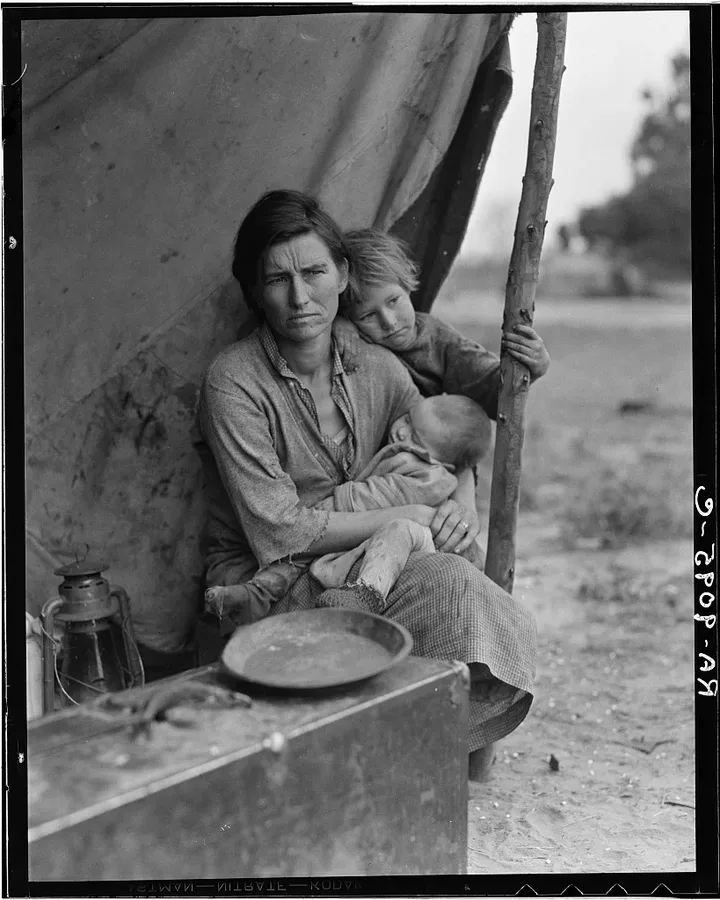
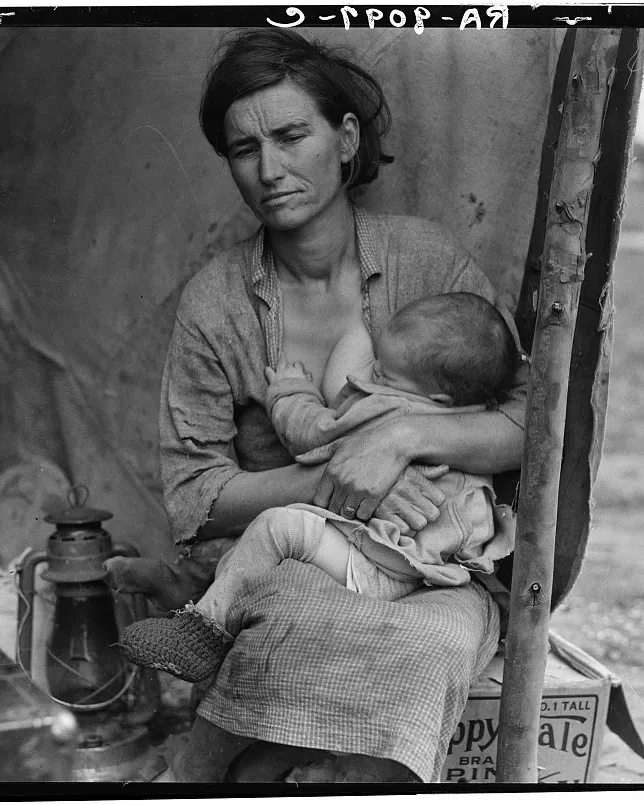
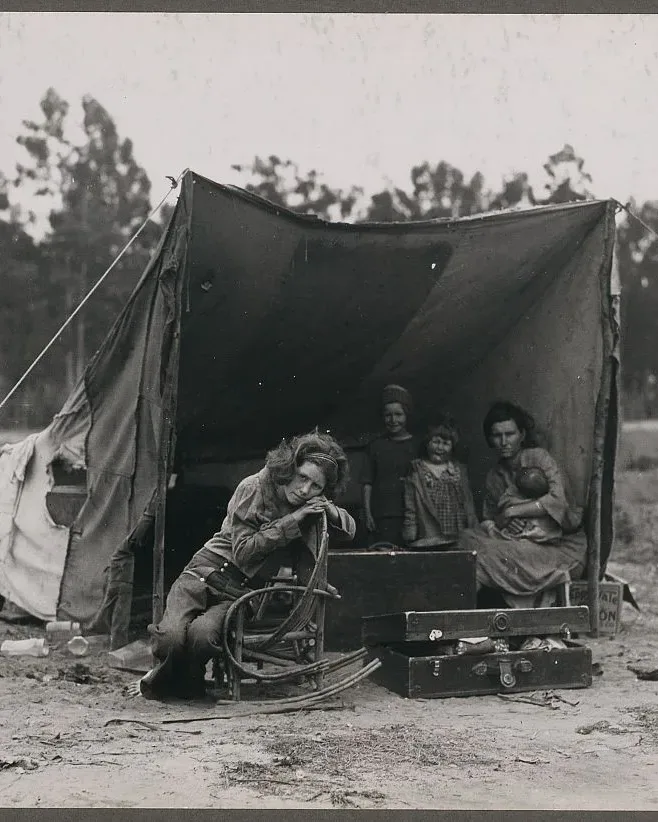
The Library of Congress holds the negatives or file prints for five frames of the Nipomo sequence. The best-known frame, catalogued under the caption "Destitute pea pickers in California," is negative LC-USF34-009058-C, and the image shown on this page is the Library's scan of that negative, with the thumb retouched out. This archive also includes the other four Library of Congress frames: a horizontal and a vertical view with Ruby leaning on her mother's shoulder (LC-USF34-009093-C and 9095-C), a view of Thompson nursing Norma (9097-C), and a wider view of the family in the tent with Viola in a rocking chair, whose original negative is now missing and survives through a file print. Their captions were probably written afterward from newspaper reports, since Lange's own notes for the batch do not mention these pictures.
Meister counts seven images of Thompson in all. Two further frames were apparently never sent to Washington and are held by the Dorothea Lange Collection at the Oakland Museum of California. Lange's own memory of five exposures and the museum count of seven are hard to square; it is possible she remembered only the five she sent in. The Library notes that the order of the frames cannot be determined, because the negative numbers were assigned later in the office.
Other versions in the archive
Frequently asked questions
Who was the woman in Migrant Mother?
She was Florence Owens Thompson, a Cherokee woman from Oklahoma who was working as a migrant farm laborer in California. Lange did not record her name in 1936, and she was publicly identified only in 1978. She died in September 1983, shortly after her 80th birthday.
Where was Migrant Mother taken?
At a pea pickers' camp near Nipomo, in San Luis Obispo County on the California coast, in March 1936. The pea crop had failed after heavy rain, leaving a large camp of workers stranded without work or food.
How many photos did Dorothea Lange take of the Migrant Mother?
Lange recalled making five exposures, and the Library of Congress holds five frames. The Museum of Modern Art's study counts seven images in all, including two held by the Oakland Museum of California that were apparently never sent to Washington.
Was the Migrant Mother photo edited?
Yes. Thompson's thumb, gripping a tent pole in the lower right corner, was retouched out of the negative in the 1930s. A print made before the retouching, showing the thumb, survives at the Library of Congress.
Is Migrant Mother in the public domain?
Yes. Lange made it as an employee of the federal Resettlement Administration, and the Library of Congress states there are no known restrictions on the Migrant Mother images. Thompson herself received little benefit from the picture.
Sources
- Library of Congress, Destitute pea pickers in California (catalog record)
- Library of Congress Research Guide: Dorothea Lange's Migrant Mother, Introduction
- Library of Congress Research Guide: Migrant Mother Series of Images
- Sarah Hermanson Meister, Dorothea Lange: Migrant Mother (Museum of Modern Art, 2018), excerpt
- HISTORY: Behind the Iconic Migrant Mother Photo
- Nevada Museum of Art, Dorothea Lange exhibition labels (National Gallery of Art loans)