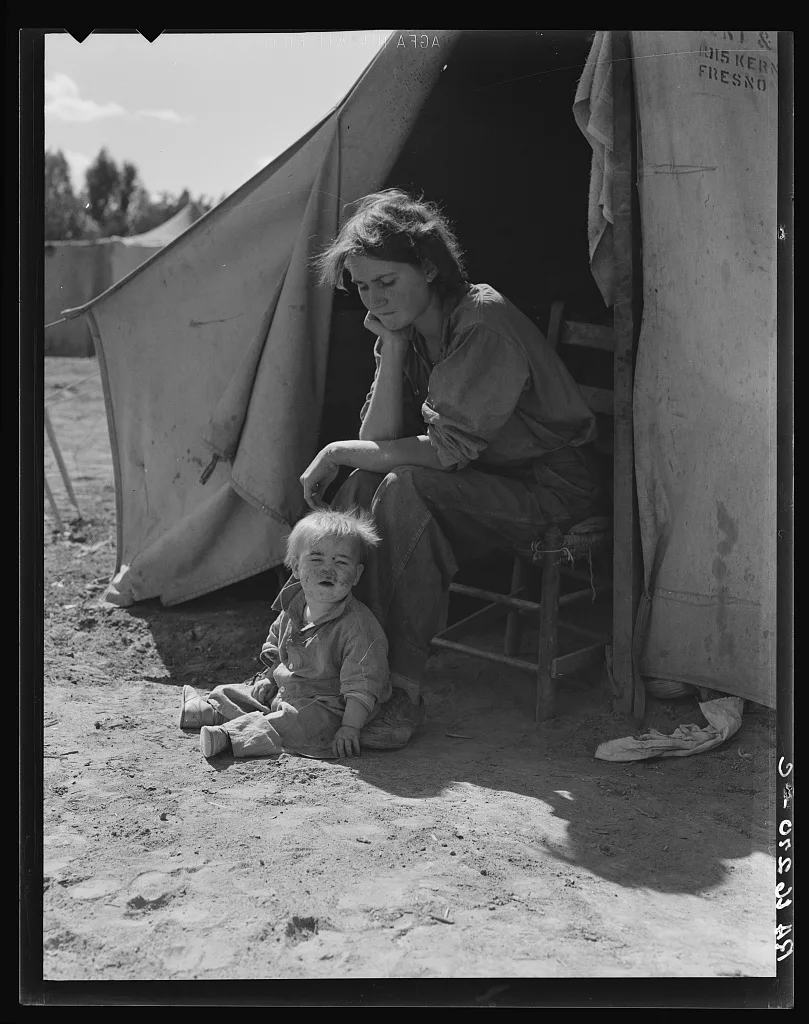
Eighteen-Year-Old Mother from Oklahoma (1937)
A young mother sits on a chair in a tent opening, chin on her hand, while her small child sits in the dirt beside her. Lange made the picture in March 1937 during a crisis among Dust Bowl migrants in California's Imperial Valley.
- Date
- March 1937
- Medium
- 4 x 5 inch nitrate film negative; gelatin silver prints
- Location
- Imperial Valley, California
- Collection
- Library of Congress, FSA/OWI Collection, negative LC-USF34-016270-C (digital ID fsa 8b31764); print at the National Gallery of Art, Washington (2016.191.32)
- Also known as
- Eighteen year-old mother from Oklahoma, now a California migrant; Eighteen-Year-Old Mother from Oklahoma, now a California Migrant
The trip that produced it
Late in 1936 a shortage of funds forced Roy Stryker, head of the government photography unit, to lay Lange off. He was able to rehire her in late January 1937, and she set out almost at once for California's Imperial Valley with her friend and assistant Ron Partridge. On February 16 she wrote to Stryker that she had been forced to switch to the valley because of conditions there: a freeze had nearly wiped out the crop, and the region was swamped with homeless families still pouring in with no work waiting for them.
The Library of Congress, which holds the negatives, notes that as many as six thousand migrants a month were arriving in California from the Plains at the time, driven by unemployment, drought and the loss of farm tenancies. Lange made ninety-seven photographs in the Imperial Valley that winter, and the Library presents this portrait among them. Its caption is simple: eighteen-year-old mother from Oklahoma, now a California migrant.
What the picture shows
The young woman sits on a straight-backed chair just inside the flap of a canvas tent. She rests her chin on one hand and looks down and away from the camera; her other hand touches the head of a small child sitting in the dirt in front of her. The child looks straight at Lange, while the mother seems lost in thought. Sunlight falls hard on the child and the ground, while the tent behind the mother is in shade.
The Library's essay on the trip singles out the mother and child in the tent opening as one of the most poignant images from it, a picture that conveys a mood rather than describing a situation. Like most of the subjects of these pictures, she is not named; the caption records only her age, her home state and her new status as a migrant. That anonymity was part of how the photographs worked: she stood for thousands of young families in the same position.
What Lange meant the photographs to do
Lange's Imperial Valley pictures were meant to build support for federal camps for migrant workers. On March 12, 1937, five days after she got home, she wrote to Stryker that her "negatives are loaded with ammunition," adding that the situation was no longer a publicity campaign for labor camps but a major migration of people. She arranged for prints to go to the state relief office in the valley and to the Resettlement Administration's regional office. Between 1937 and 1940, according to the Library of Congress, the pictures from this trip were used in a report to the U.S. Senate, in An American Exodus, in a Works Progress Administration exhibit in San Francisco, and in newspapers and magazines.
Lange also hoped to place a story in Life magazine. She put together twenty-five pictures on the theme of human erosion, limiting them to California because, she told Stryker, that would make "a more pointed story." Disagreements over who should submit and edit the material got in the way, and in the end only one of her migrant photographs from the trip appeared in Life: a full-page close-up of a man with a defiant glance, at the end of a six-page spread on the Dust Bowl in the issue of June 21, 1937.
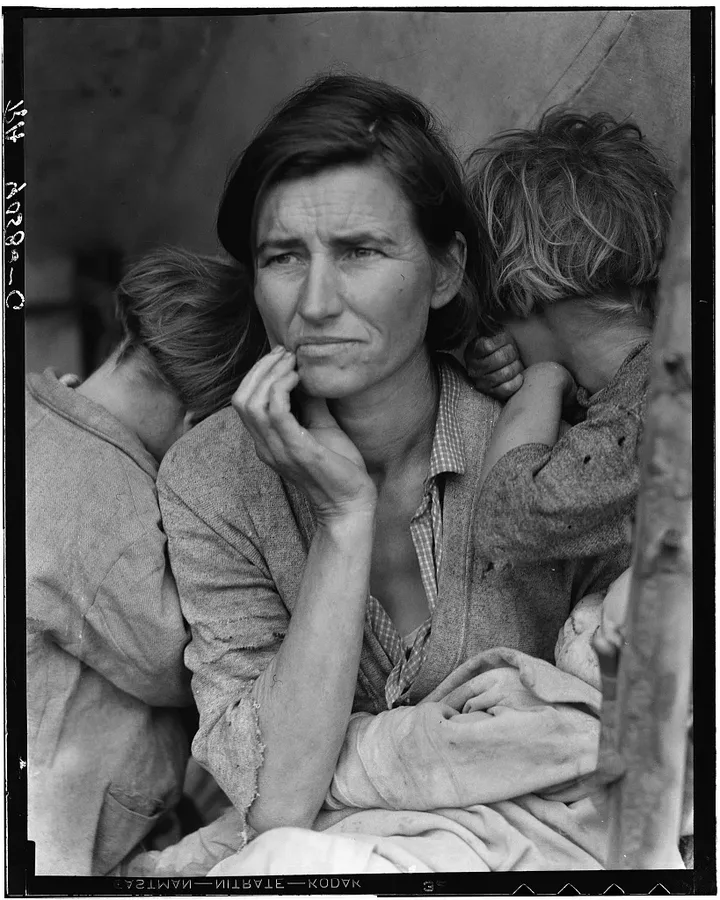
Comparing it with Migrant Mother
It is hard to look at this picture without thinking of Migrant Mother, made a year earlier at Nipomo. Both show a mother at a tent, a hand raised to the face and children close by. The differences are telling. At Nipomo Lange moved in until the mother filled the frame. Here she stays back far enough to show the tent, the chair, the bare ground and the child at her feet, so the setting explains as much as the face does. The mother's downward gaze also makes her seem more private and less like a symbol.
Versions and the frames in this archive
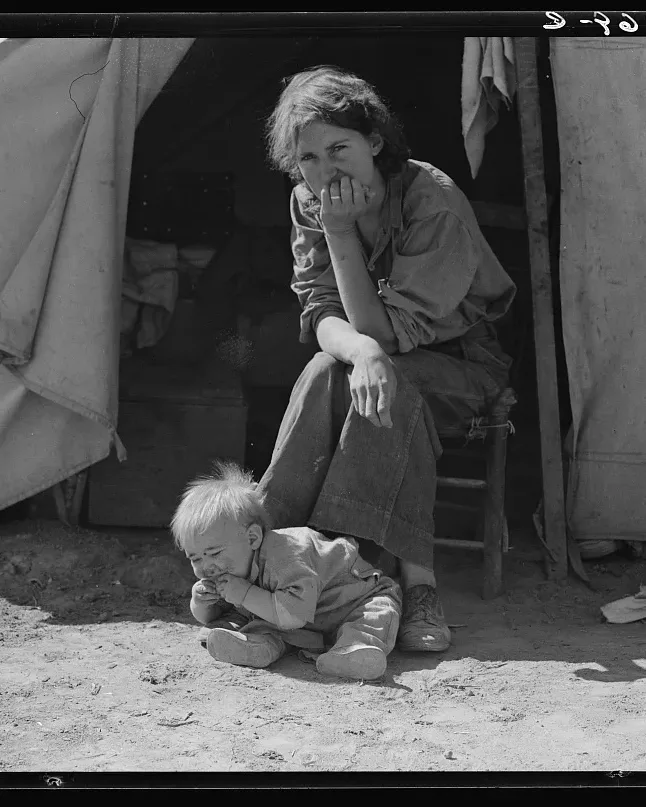
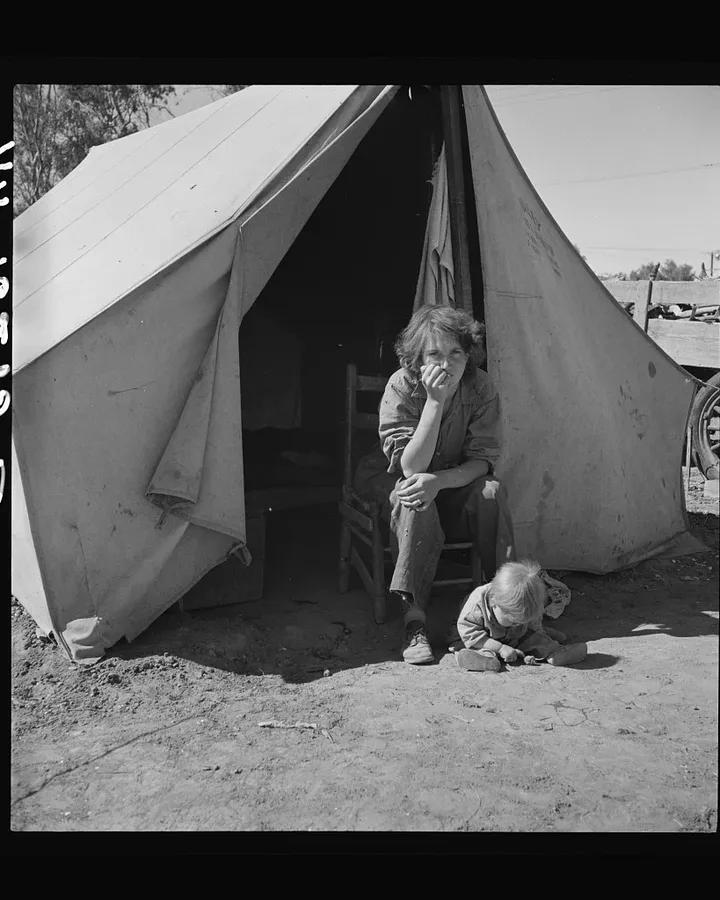
Lange made several exposures of the mother and child. The image on this page is negative LC-USF34-016270-C, the frame the Library of Congress uses to illustrate its essay on the Imperial Valley trip. This archive also holds two related frames: LC-USF34-016269-C, a horizontal 4 x 5 inch view in which the mother looks toward the camera, and LC-USF34-016285-E, a square view on smaller roll film taken from farther back that shows the whole tent. A print of the subject titled Eighteen-Year-Old Mother from Oklahoma, now a California Migrant is in the collection of the National Gallery of Art in Washington.
Other versions in the archive
Frequently asked questions
Who was the eighteen-year-old mother in Dorothea Lange's photograph?
Her name was not recorded. The Farm Security Administration caption describes her only as an eighteen-year-old mother from Oklahoma who had become a California migrant.
Where was the photo taken?
In the Imperial Valley of southern California, in March 1937, during a trip Lange made to document a crisis among migrant families after a freeze destroyed much of the crop.
Is this the same woman as Migrant Mother?
No. Migrant Mother shows Florence Owens Thompson at Nipomo in March 1936. This photograph was made a year later in the Imperial Valley and shows a different, much younger woman.
Where can I see the original?
The original negative is in the Library of Congress FSA/OWI Collection and has been digitized. The National Gallery of Art in Washington owns a print.
Sources
- Library of Congress, Eighteen year-old mother from Oklahoma, now a California migrant (catalog record, LC-USF34-016270-C)
- Library of Congress, Eighteen year-old mother from Oklahoma (catalog record, LC-USF34-016269-C)
- Library of Congress, Documenting America: Migrant Workers (Dorothea Lange, Imperial Valley, 1937)
- Nevada Museum of Art, Dorothea Lange exhibition labels (National Gallery of Art loans)